Smile Visualization
Take a smiling selfie and we’ll show you what Invisalign® treatment can do for you. Sometimes insurances can cover upto $2500 of invisalign treatment. Call our office or follow the link to find out.

Modern materials and refined techniques have transformed denture care, making tooth replacement more natural-looking and comfortable than ever. While fixed solutions such as dental implants and bridgework are excellent options for many patients, removable dentures continue to be a reliable and versatile way to restore a complete smile when appropriate.
Our team emphasizes precise fit, long-term function, and an appearance that complements each person’s facial profile. Thoughtful design and careful fabrication allow dentures to support speech, chewing, and self-confidence while preserving oral health.
Below, you’ll find a clear, patient-friendly guide to how dentures work, the choices available, what to expect during treatment, and how to care for your prosthesis so it lasts and performs well.
Tooth loss affects much more than the way a smile looks. Missing teeth change how your bite functions and how forces are distributed across your jaw, which can lead to uneven wear on remaining teeth and discomfort when chewing. Over time, untreated gaps may contribute to shifting teeth, altered speech patterns, and changes in facial support.
Beyond function, there are real nutritional and social consequences. People with untreated tooth loss often limit certain foods, which can reduce dietary variety and impact overall nutrition. Socially, gaps in the smile can make people more self-conscious about speaking and smiling, altering their willingness to engage in personal and professional situations.
Addressing tooth loss with an appropriate prosthetic — whether a partial denture, full denture, or an implant-supported option — helps restore efficient chewing, supports healthy jaw relationships, and preserves the appearance of the lower third of the face by reestablishing tooth height and lip support.
Removable dentures are custom-made appliances that rest on the gums and underlying bone to replace missing teeth. They combine artificial teeth set in a base that is shaped and shaded to mimic natural tissues. A successful denture relies on accurate impressions, careful bite records, and skillful laboratory work to recreate proper alignment and function.
Functionally, dentures restore the surfaces needed for chewing and help guide the bite so tongue and cheek muscles can work more effectively. Properly contoured denture bases also support facial soft tissues, which helps maintain a natural facial appearance and prevents the “collapsed” look that can result from long-term tooth loss.
Because dentures are removable, they provide the advantage of easy cleaning of both the oral tissues and the prosthesis itself. For many patients, that removability makes ongoing oral hygiene simpler and allows for periodic adjustments that keep the fit comfortable as tissues change over time.

Choosing the right type of denture depends on how many teeth are missing, the condition of the remaining teeth and gums, bone support, and personal preferences for maintenance and function. Broadly, removable solutions fall into two categories: full (complete) dentures and partial dentures; both can be adapted with additional features for improved stability.
Full dentures replace all teeth in the upper or lower jaw. They are designed to distribute chewing forces evenly over the tissues and are carefully shaped to optimize retention through suction and intimate contact with tissues. In contrast, partial dentures are used when some natural teeth remain; they fill gaps, preserve the position of adjacent teeth, and restore a balanced bite.
For patients seeking extra retention, dentures can be modified with attachments that connect to prepared natural teeth or to dental implants. These hybrid approaches combine the convenience of a removable prosthesis with the stability of fixed connections, improving comfort and confidence when speaking or eating.
Complete dentures are customized to replace an entire dental arch. The fabrication process emphasizes achieving proper tooth position, lip support, and occlusion so the prosthesis looks and functions harmoniously with the patient's facial features. Modern materials allow clinicians to craft lifelike tooth anatomy and gum tones that blend naturally with the smile.
An immediate denture is placed soon after extractions so the patient never goes without teeth while healing occurs; it offers immediate aesthetics but typically requires follow-up adjustments or relining as tissues remodel. A conventional (delayed) denture is made after healing is complete for a more stable long-term fit. Implant-assisted or implant-retained dentures use small implants to anchor the prosthesis, providing increased support and significantly reducing movement during use.
Partial dentures are tailored to fit around existing teeth and use clasps or precision attachments to gain retention. Besides replacing missing teeth, a well-designed partial helps prevent unwanted drift of adjacent teeth and preserves the patient’s bite by filling in functional gaps.
Frame materials range from metal alloys to flexible resins and newer hybrid composites, giving clinicians options to balance strength, comfort, and aesthetics based on each patient’s clinical needs and preferences.
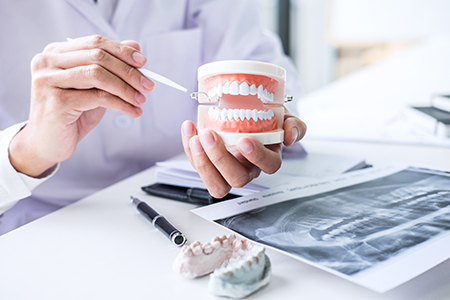
A successful denture begins with a thorough evaluation: medical and dental history review, tissue assessment, and diagnostic imaging when needed. During the consultation, clinicians assess oral health, look for any disease that must be treated first, and outline an individualized plan that supports both function and appearance.
Impressions and bite records are taken with care to capture the exact relationship between the jaws and to determine the best tooth position and vertical dimension. Lab work includes selecting tooth shape and shade, arranging teeth in wax for try-in, and making any necessary adjustments before processing the final prosthesis.
The insertion visit is followed by a period of adaptation. Minor adjustments after delivery are common as the tissues settle and the patient learns to speak and chew with the new denture. Good communication between the patient and the clinician during this period ensures that fit, comfort, and function are optimized.

Adjusting to a new denture takes time and patience. Initially, increased salivation, slight speech changes, and localized sore spots are normal, but these typically resolve as you become accustomed to the appliance. Practicing speech and gradually progressing from soft to firmer foods helps speed adaptation.
Everyday care is straightforward but essential: rinse and brush the denture daily with a brush designed for prostheses, soak according to the manufacturer’s recommendations, and maintain rigorous oral hygiene for any remaining teeth and soft tissues. Removing dentures at night gives the gums an important rest and supports tissue health.
Over months and years, the shape of the gums and jawbone can change. Routine follow-up visits allow your clinician to assess fit, make relines or adjustments, and monitor oral tissues for any issues. In cases where retention decreases, relining or converting to an implant-assisted solution can restore comfort and function.
Choosing to replace missing teeth is a step toward better oral function and renewed confidence. Our clinicians focus on individualized care—reviewing your needs, explaining realistic expectations, and guiding you through each stage from diagnosis to long-term maintenance.
At the office of Fuller Smiles San Fernando Valley, we combine careful clinical evaluation with modern fabrication techniques to deliver dentures that look natural, fit well, and support healthy oral function. We aim to make the process clear and manageable so patients feel informed and comfortable with their treatment choices.
If you have questions about whether a removable denture, an implant-assisted option, or another approach best fits your situation, please contact our office for more information. We’re here to help you explore options and plan a path to a complete, healthy smile.

Today, it’s easier than ever to replace missing teeth and achieve natural-looking, durable, and long-lasting results! Depending on a patient’s dental needs, lifestyle, expectations of care, and budget, choices can include conventional fixed bridgework, dental implants, or removable partial and complete dentures. At the office of Fuller Smiles San Fernando Valley, we’ll discuss all your options in care and answer all your questions as you choose the solution that’s right for you.
With advances in dental materials and technology, today’s dentures are more comfortable and realistic-looking than ever before.
Whether you wear partial or complete dentures, it’s essential to see the dentist for routine care. Besides checking the fit and condition of your dentures and making any necessary adjustments, you’ll also receive a comprehensive exam to check on the health of any remaining teeth as well as the soft and hard tissues in and around the oral cavity.
A same-day denture offers an accelerated design and fabrication process that allows a patient to go from impression taking to denture insertion in a single day.
For patients who don’t want to wait after having teeth extracted, an immediate denture can be inserted the same day your teeth are removed. Sometime later you may need the denture relined to address any changes in its fit once the extraction sites have completely healed.
While no one wants to drop or break a partial or complete denture, accidents do happen. The good news is that in some cases, your partial or complete denture is reparable. It all depends on the extent of the damage. Don’t hesitate to contact our office if you’ve broken or damaged your denture. We’re happy to help.
The simple act of taking your partial denture in and out can cause certain types of metal clasps to loosen over time. When you come in for your checkup visit or contact our office for an adjustment, we’ll assess the fit of your partial and tighten the clasps for improved stability and comfort.
While rebuilding a complete smile is a worthwhile investment, our office is sensitive to the costs involved in dental care. We customize care and will discuss which treatment options address your needs, lifestyle, and budget. How much a new denture will cost depends on the type of the prosthesis, its design, and the materials used to fabricate the supportive base, teeth, and clasps or precision attachments. Dentures that include the placement of dental implants for added retention and stability typically involve additional costs.
If you have dental insurance, your coverage may include a new or replacement set of dentures. Our staff is happy to review your coverage with you to ensure you are maximizing your insurance benefits while minimizing any out of pocket expenses.
At the office of Fuller Smiles San Fernando Valley, we provide an extensive range of dental services, including the latest and most effective methods to help patients with missing teeth rebuild complete and beautiful smiles. As skilled and experienced professionals, we recognize that every patient is different, and every smile is unique. We’re passionate about what we do and take great pride in providing personalized treatment plans while treating our patients as valued partners in care.
Dentures are removable prosthetic devices that replace missing teeth and the surrounding gum tissue. They consist of artificial teeth set into a base that rests on the gums and is shaped to support facial contours and oral function. Dentures restore basic chewing and speaking ability while improving the appearance of the smile and lower facial profile.
Removable dentures can replace a few teeth or an entire arch, and they are designed to be taken out for daily cleaning and overnight rest. Modern materials and fabrication techniques produce natural-looking results and improved comfort compared with older prostheses. A well-made denture also helps maintain proper spacing and alignment among remaining teeth when partial replacements are used.
Full dentures, also called complete dentures, replace all of the teeth in either the upper or lower jaw or both, while partial dentures replace one or more missing teeth when some natural teeth remain. A partial denture usually uses clasps or precision attachments that anchor to adjacent teeth to stabilize the prosthesis. Full dentures rely on an accurate fit to the gums and underlying bone, and in some cases may be supported further by implants or attachments.
The choice between full and partial dentures depends on the number and condition of remaining teeth, the health of the gums and bone, and the desired functional and aesthetic outcomes. Your clinician will evaluate oral structures and discuss which design best balances comfort, stability, and maintenance. Both types are removable to allow effective cleaning of the prosthesis and the oral tissues beneath it.
Implant-supported dentures attach to dental implants placed into the jawbone to provide enhanced retention and stability compared with traditional removable dentures. Small titanium posts are surgically inserted and allowed to integrate with the bone, creating secure anchor points for the denture to clip or screw onto. This approach can significantly reduce movement during eating and speaking and improve overall comfort.
Implant-supported solutions are often recommended when a patient seeks greater function than conventional dentures can deliver or when ridge anatomy limits denture stability. The number and placement of implants are planned based on bone availability and prosthetic objectives, and the treatment may involve a staged process with healing time between implant surgery and final prosthesis attachment. A consultation with imaging and clinical evaluation determines candidacy and the optimal implant approach.
The denture fabrication process begins with a comprehensive oral exam and diagnostic imaging to assess tissues, remaining teeth, and bone structure. The clinician then takes detailed impressions and records of bite relationships to create a customized plan for tooth arrangement, shape, and color. Laboratory steps include creating a model, wax try-ins for esthetic and functional verification, and processing the final prosthesis in durable denture materials.
Fitting appointments focus on achieving a comfortable and functional fit, with adjustments made as needed during follow-up visits. For immediate dentures, the prosthesis is placed at the time of extractions and then refined as tissues heal. Whether conventional or immediate, careful attention to occlusion, phonetics, and tissue support is essential to long-term success.
Adjustment to new dentures varies by individual but generally takes several days to a few weeks for most people to become comfortable with speaking and eating. Early experiences commonly include increased saliva production and a sensation of bulk in the mouth, both of which typically subside as oral tissues adapt. Practicing speech and starting with soft foods while gradually reintroducing firmer items can speed functional adaptation.
Minor sore spots or pressure areas are common during the initial period and can be relieved with short follow-up visits for selective adjustments. If problems persist beyond the expected adaptation window, a clinical re-evaluation is important to identify fit issues or necessary refinements. Regular follow-up ensures the denture continues to function properly as tissues change over time.
Daily cleaning is essential to maintain denture appearance and oral health: rinse dentures after eating, brush them gently with a nonabrasive denture brush, and soak them nightly in water or an appropriate denture-cleaning solution. Avoid hot water and abrasive household cleaners, which can warp or damage the prosthesis. Cleaning the denture prevents plaque buildup, staining, and odors.
It is also important to maintain oral hygiene of any remaining natural teeth, gums, tongue, and palate by brushing and rinsing regularly. Remove dentures at night to allow oral tissues to rest and reduce the risk of irritation or infection. Bring the denture to dental visits so the clinician can evaluate its condition and the health of the supporting tissues.
Yes. Dentures can often be adjusted, relined, or repaired in the dental office or laboratory to restore fit and function when they become loose, cracked, or worn. Relining reshapes the tissue-bearing surface to compensate for changes in the gums and bone, improving stability and comfort. Simple repairs, such as replacing a broken tooth or mending a fracture, can frequently be completed quickly by a trained technician.
Temporary at-home fixes are not recommended because they can cause further damage or an improper fit; professional evaluation ensures the repair or adjustment maintains the prosthesis’ integrity and oral health. If a denture repeatedly becomes unstable despite relines and repairs, an alternative treatment plan, including implant support or a remake of the prosthesis, may be considered based on clinical findings.
Properly designed dentures support the lips and cheeks, helping to preserve facial contours that can change after tooth loss. By restoring vertical dimension and tooth position, dentures can improve bite relationships and reduce the collapsed look that often accompanies missing teeth. The design process carefully considers tooth height, placement, and occlusion to achieve both functional and aesthetic goals.
Over time, natural bone and soft tissues may remodel, which can alter how the denture fits and how facial support is maintained. Periodic assessments and relines help preserve bite alignment and facial appearance; in some cases, different prosthetic designs or implant-supported options can offer improved long-term support. A clinician will monitor these changes during routine visits and recommend appropriate interventions.
Candidates for dentures include patients who have lost multiple teeth or full arches and seek a removable solution to restore appearance and function. Suitability depends on oral health factors such as gum tissue condition, bone structure, the presence of remaining teeth, and overall medical status. A thorough examination and imaging help determine whether a conventional, immediate, partial, or implant-supported denture is most appropriate.
Patients with adequate healing potential and realistic expectations about adaptation and maintenance tend to do well with dentures, while those with certain systemic conditions or severe ridge resorption may require additional planning or alternative treatments. A consultation at a dental office, including review of health history and clinical findings, will clarify candidacy and outline the recommended care pathway.
Follow-up care includes short-term visits to adjust fit and relieve sore spots, followed by routine examinations to monitor oral health and the condition of the denture. During these appointments the clinician checks for tissue changes, evaluates occlusion, and recommends relines or repairs as needed to maintain comfort and function. Regular oral exams also allow early detection of issues such as mucosal irritation or changes in remaining teeth.
At Fuller Smiles San Fernando Valley our clinicians coordinate follow-up schedules and provide instructions for home care to maximize prosthesis longevity and oral well-being. Maintaining scheduled visits and reporting any persistent discomfort, instability, or functional concerns helps ensure the denture continues to meet your needs. Ongoing care supports both the health of oral tissues and the long-term success of the prosthesis.
Take a smiling selfie and we’ll show you what Invisalign® treatment can do for you. Sometimes insurances can cover upto $2500 of invisalign treatment. Call our office or follow the link to find out.